Ten practical preparation steps for driving across Northern Norway, Northern Sweden and Northern Finland.
Prepare for the season you are driving in
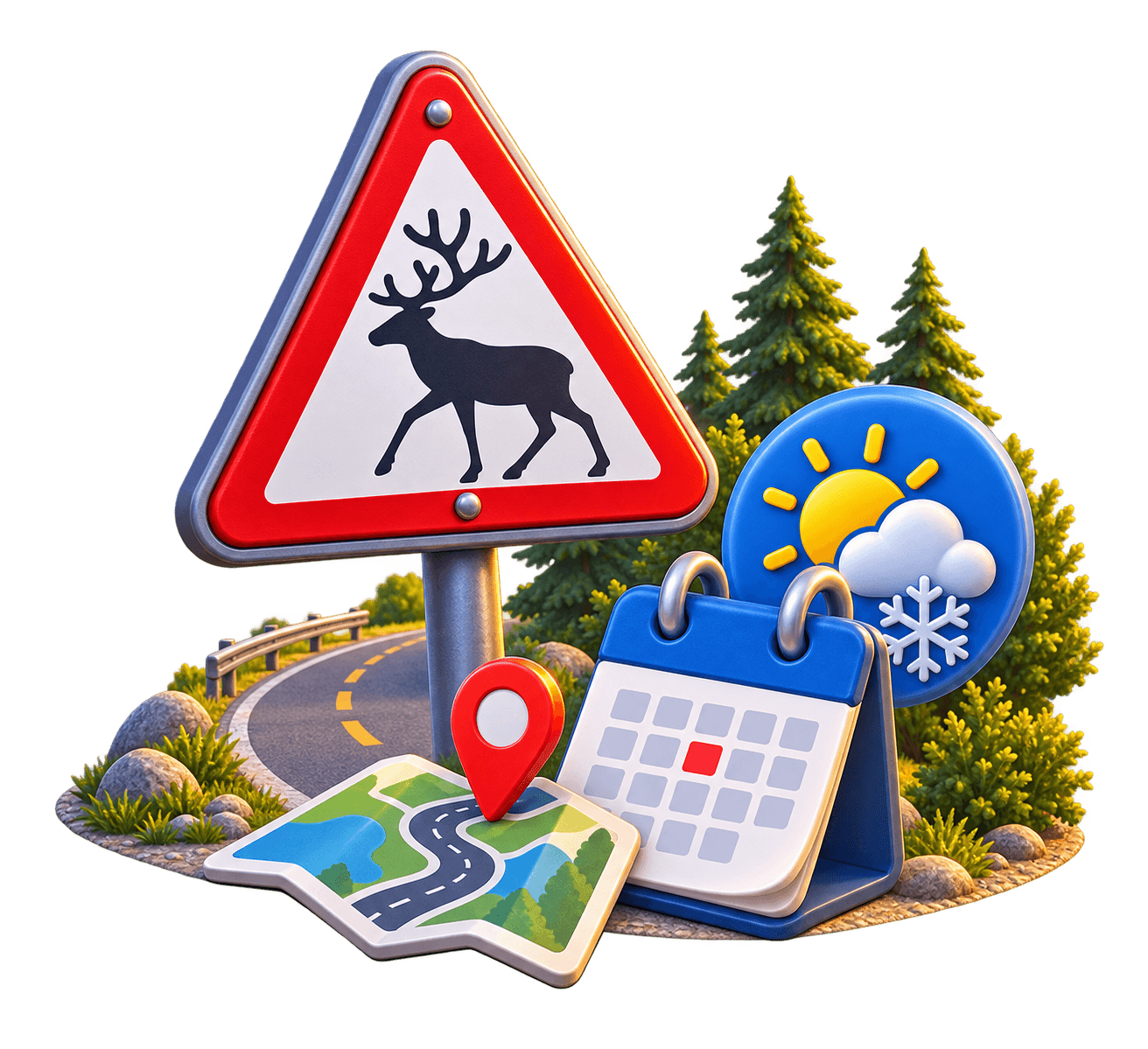
The ten steps below apply to every season. Winter carries the highest physical risk. Summer carries the highest distraction and fatigue risk. Season windows are approximate — weather does not follow the calendar.
Winter / Polar Night
Roughly October – April
Ice and black ice — often invisible on the road surface
Polar night: weeks of complete darkness in midwinter
Braking distance on snow and ice 5–10× longer than on dry road
Mountain-pass closures and avalanche risk on exposed routes
Summer / Midnight Sun
Roughly May – September
Sun does not set: fatigue builds without the usual warning signs
Cyclists and reindeer on narrow scenic routes
Camper vans, coaches and rentals on roads sized for local traffic
Roadworks and ferry queues that add hours to routes
Phase · Before travel
Set expectations before you land.
Check the weather forecast for your arrival day and the following 48 hours.
Check official road conditions for your planned first route. Some mountain roads and passes may close seasonally.
Understand the season you are arriving in. Winter driving conditions — darkness, ice and snow — are common from October into April and can still occur in May, especially at higher ground. May to September is generally milder, with long daylight and possible fatigue from midnight sun, but weather can change quickly.
If arriving November–January, note that polar night means very limited or no daylight. Plan routes and return timing accordingly.
Add arrival date, rental pickup time, and first planned drive to the NorPilot Calendar.
Check whether public holidays in Norway, Sweden or Finland fall during your trip. Shops, fuel stations and some services may have reduced hours or close.
Ask what type of winter tyres the car has: studded or non-studded. Studded and non-studded winter tyres are both used across the Nordic north, depending on country, vehicle and conditions. If you have little or no winter driving experience, ask whether the fitted tyres are suitable for your planned route and current conditions. In icy conditions, studded tyres may give better grip. If you are unsure, ask before driving away. The rental company is responsible for the vehicle's tyre specification — but the decision to drive rests with you.
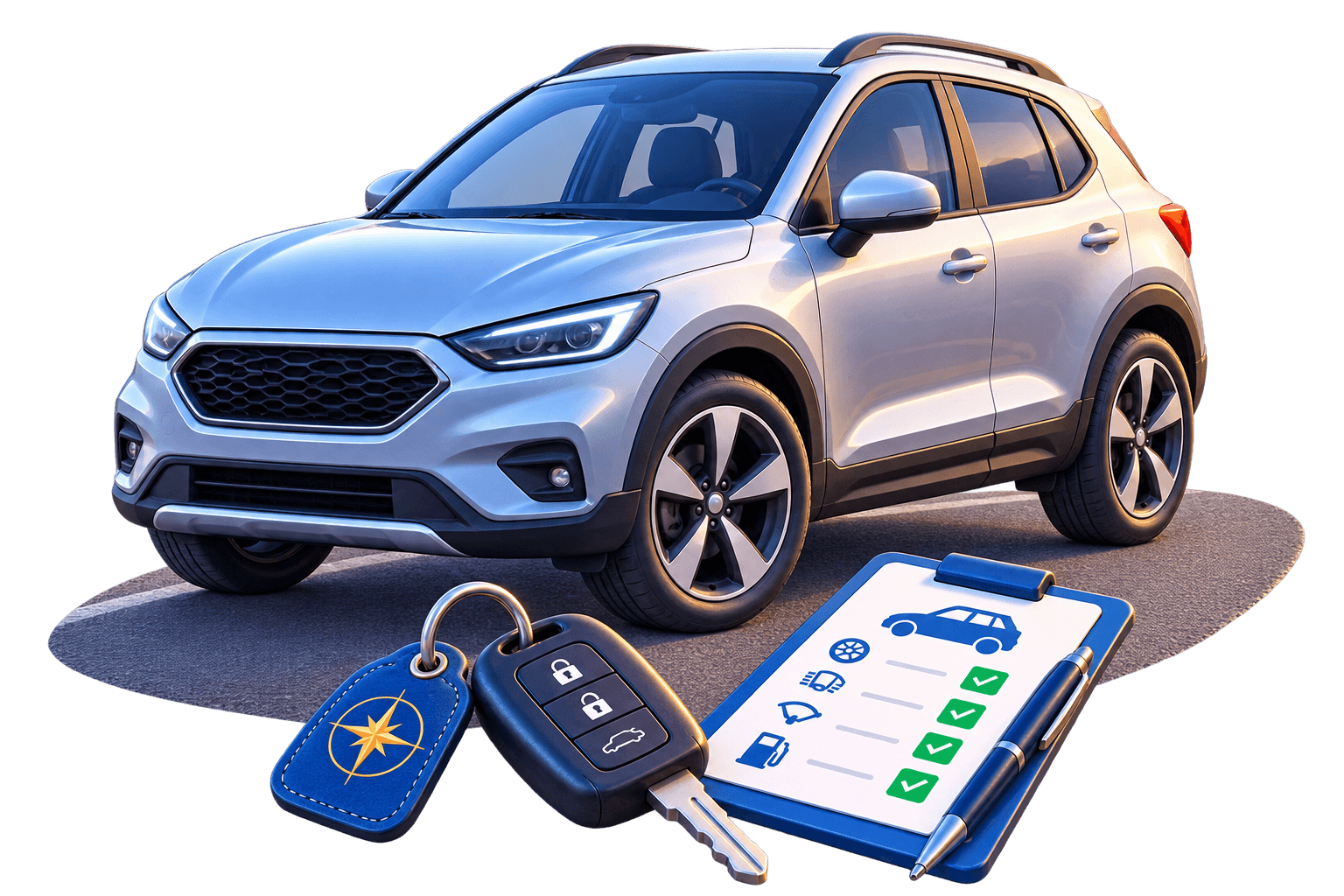
Check that a reflective vest (high-visibility vest) is inside the car and reachable from the driver's seat without opening the door. If the car stops or breaks down on the road, put on the reflective vest before leaving the vehicle — not after. Ask the rental staff to show you where it is stored.
Check that a warning triangle is present and find out where it is stored. If the vehicle must stop in a potentially dangerous position, the triangle should be placed at a safe distance behind the car. Ask the rental desk if you cannot locate it.
If the reflective vest, warning triangle, or any other safety or winter equipment is missing or unclear — ask the rental company before driving away. Do not assume it is somewhere in the car.
Walk around the car and photograph all existing damage before signing anything. This protects you at return.
Check that headlights, tail lights, and interior lights work. In polar night conditions, driving with a faulty light is a safety risk and can result in a fine.
Do a short test drive near the rental area before committing to a long route. Feel how the car brakes, accelerates, and handles on the current road surface.
Check road conditions and weather one final time before leaving. Conditions can change quickly in the Nordic north — even within an hour.
Plan your return time before you leave. In winter, darkness can arrive quickly. In summer, midnight sun means there is no natural signal to turn around.
Drive slower than you think is needed — especially on the first day. Ice is often invisible (black ice). Your braking distance on ice can be 5–10 times longer than on dry road.
Keep a large following distance to the car ahead. At least 3–4 seconds in normal conditions. More on ice or snow.
Do not follow GPS blindly. GPS does not distinguish between public roads, private roads, ski tracks, and seasonal forest tracks. If a road looks wrong — stop and verify. Do not continue.
Coming from left-hand traffic? Take extra care at junctions, roundabouts and when rejoining the road — Norway, Sweden and Finland drive on the right.
Never stop on the driving lane or on a narrow road shoulder at night, especially on 80 km/h roads. Other cars will not expect a stationary vehicle.
Use marked pullouts, signed viewpoints, and proper parking areas. These are specifically designed for stops and are legal.
When stopping for aurora at night, turn off your headlights to protect the aurora experience for others — but make sure your hazard lights are visible to other drivers.
Do not ask the driver to slow down or stop in unsafe places. Passenger distraction is a documented cause of wrong stops. Help the driver by planning stops before the drive, not impulsively.
Reindeer and other animals are often attracted to road shoulders at night. Do not exit the car near road edges without checking for wildlife.
If you want to photograph the aurora, plan the stop in advance using the NorPilot Calendar or Routes. Identify legal pullouts before you leave, not while driving.
Animals are a year-round risk across the Nordic north. Reindeer and moose are the high-risk large animals. Sheep are especially common on roads and mountain pastures in summer. Domestic animals (cats, dogs) can cross near villages, farms and houses. Smaller wild animals may appear suddenly. Watch animal warning signs and adjust speed.
Reindeer are specifically attracted to salted road surfaces — they lick the salt. You will encounter them most often on the main roads, especially at dusk and dawn, and especially from September to April.
If you see a reindeer on or near the road, slow down significantly. One animal usually means more nearby.
Do not honk aggressively — it can cause reindeer to panic and run across the road unexpectedly.
Moose (elg) are large, dangerous at highway speed, and most active at dusk and dawn. On moose-risk roads, drive slower in low light.
In summer (June–October), sheep are released onto mountain pastures and roam freely across roads. Unlike reindeer, sheep scatter in unpredictable directions when startled. If you see sheep near the road, slow down well in advance. Do not honk — they may run directly into the car's path.
Most driving mistakes by tourists happen on the first day after a long international flight. If you arrive late and tired, do not drive to a remote location that same evening. A short drive to your hotel only, then rest. A well-rested driver tomorrow is safer than an exhausted driver tonight.
If visibility is less than 50 metres, slow down significantly or stop at a safe pullout and wait. Turn on hazard lights if stopped. Do not drive faster than conditions allow because the GPS says you should arrive in 30 minutes. Arrival time is less important than arriving safely.
Many roads in Northern Norway are single-lane with passing places. If you meet oncoming traffic, the driver closest to a suitable passing place normally gives way — sometimes by reversing to it. Drive slowly on single-lane roads so you have time to react. Do not panic — this is routine for local drivers and visitors who know what to expect.
If a road surface changes unexpectedly (from tarmac to unmarked snow, narrow track, or no visible road ahead), stop immediately. Turn around calmly and return to the last clearly signed public road. GPS has led tourists onto ski slopes and private farm tracks in Northern Norway. Trust your eyes over the GPS.
Snow plows are wide, slow, and spread grit and snow to the side. Keep a very large following distance — at least 100 metres behind a snow plow. Do not overtake unless the plow signals it is safe and there is a clear overtake zone. Passing a snow plow is genuinely dangerous. Wait.
Arriving tired after a long flight
Most driving mistakes by tourists happen on the first day after a long international flight. If you arrive late and tired, do not drive to a remote location that same evening. A short drive to your hotel only, then rest. A well-rested driver tomorrow is safer than an exhausted driver tonight.
The most common unsafe aurora photo situation is an impulsive stop. The passenger says "stop here!" and the driver pulls over onto an 80 km/h road shoulder in darkness. Plan aurora stops before you drive — identify legal pullouts from the NorPilot Routes page or Calendar. Then execute the plan calmly, not impulsively.
The midnight sun creates a biological trap. The sky is bright at 2am, your body does not receive the darkness signal that normally triggers sleep, and fatigue accumulates without the usual warning signs. Many visitors drive far longer than intended without realising how tired they are. Before any summer drive, set a hard return time and stick to it — regardless of how bright the sky looks or how alert you feel.
In summer, Northern Norway's scenic roads attract serious long-distance cyclists. On narrow roads with no shoulder — common on fjord routes, Lofoten, and mountain passes — you may encounter a cyclist on a blind corner, inside a tunnel, or on a single-lane bridge with no warning. Reduce speed on any narrow road where you cannot see 150 metres ahead. When overtaking, leave at least 1.5 metres of clearance and wait for a clear, straight section.
Supply and timber trucks up to 25 metres long share the E6 and E10 with tourist traffic. On narrow sections, a passing truck will come very close — the wind shake as it passes is normal. Reduce speed well before the pass, stay as far right as you safely can, and keep both hands on the wheel. Do not brake sharply as a truck approaches. If you feel uncertain, pull into the next passing place or layby and let the truck pass before continuing.
Several bridges and coastal road sections in Northern Norway are exposed to strong side wind. Wind can arrive suddenly on a bridge — particularly in late autumn and winter. Reduce speed on approach to any bridge in poor weather or when wind is forecast. Hold the steering wheel firmly through the crossing. If you feel the car pulling sideways, slow down — do not accelerate. If conditions feel genuinely unsafe at a bridge approach, it is acceptable to wait.
112 works in Norway, Sweden and Finland. Call it only in an emergency that needs immediate help. Emergency services are organised differently in each country.
For breakdowns or vehicle problems, contact your rental company’s roadside assistance.