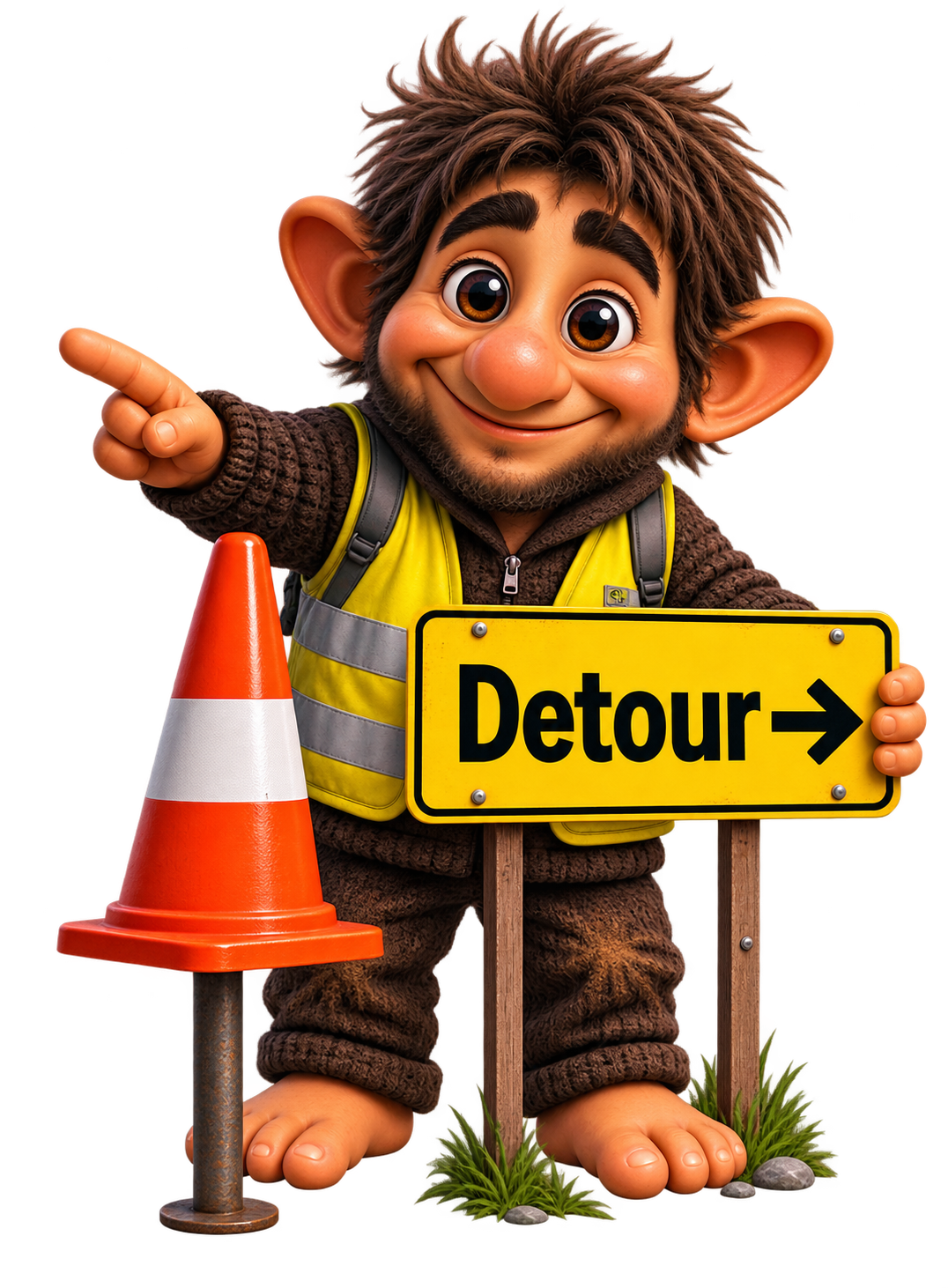
In summer, roadworks are part of the route
The northern building season is short, so roads can only be repaired and rebuilt during the warm months — the same weeks you are visiting. Meeting roadworks in an Arctic summer is completely normal and expected, not bad luck. Across Norway, Sweden and Finland, summer is when the work happens. The calm driver treats it as a normal segment of the drive, like a ferry crossing or a gravel stretch.
- Expect any of these: temporary traffic lights, a worker holding a stop/go sign, single-lane sections, a pilot car leading a convoy, reduced speed limits, machinery and workers on foot, dust, fresh loose gravel, and signed detours.
- This is routine for locals, and all that is asked of you is to follow the instructions calmly. None of it is dangerous in itself.
- Build a little buffer into the day. A few minutes' wait at a light or a slightly longer detour costs you almost nothing if your plan was not already on a knife-edge.
- Roadworks happen across all three countries in summer for the same reason — the short season concentrates the year's work into the months you are driving.
Roadworks are not a delay outside the trip. In summer, they are part of the route. Expect them, leave a little buffer, and they stop being stressful.
Temporary traffic lights and stop/go
The most common roadwork encounter is a temporary traffic light controlling a single lane that traffic shares in both directions. It is holding you because you cannot see the far end of that lane — and that is exactly why it matters most when the road looks empty.
- A red light on an empty remote road is still fully binding. 'No cars and no workers in sight' is not permission to go — it is the very situation the light exists to manage. There may be oncoming traffic, a pilot car, or work happening out of sight around a bend or over a crest. Wait for green.
- Waits can be several minutes on long single-lane sections, especially where a pilot car is running the other direction through first. This is normal. Stay in your lane, stay calm, and do not creep forward or try to turn around.
- A worker holding a stop/go sign has the same authority as the light. Follow the worker's signal — and if a worker waves you on differently from what you expected, follow the worker.
- If the light seems to be taking a long time, it is almost always simply on a long cycle for a long lane — not broken. Patience is the right response, not creeping forward.
A red light in the middle of nowhere is still a red light. The wait is short and certain; going through it is the risk.
The pilot car: convoy driving
On longer or more complex single-lane sections, a pilot car leads vehicles through the work zone in a convoy. If you have never been led through roadworks this way, it is simple: when it arrives and you are waved to follow, you go with it.
- The pilot car (Norwegian: ledebil / følgebil; Swedish: lots; Finnish: saattoauto) leads the line through at a safe pace for the conditions. Pull in behind it and follow. Pilot cars are used at roadworks in all three countries.
- Keep a sensible gap, stay in line, and do not overtake within the convoy or try to pass the pilot car. It is setting the speed for narrow lanes, loose surfaces, machinery and people on foot.
- Do not drop far behind either. The convoy moves as a group through a window when the lane is clear; falling back can leave you alone in a section that is about to carry oncoming traffic.
- At the far end the pilot car will pull aside or signal. Resume normal driving only once you are clear of the work zone and back on open road.
When a pilot car leads, follow it as a group: in behind, matched pace, no overtaking, no falling back. For a few minutes you simply follow — and that is the safest thing to do.
Inside the work zone: slow down, give workers room
A work zone is a place to be patient and gentle, not quick. The reduced speed limit is there because of narrow lanes, uneven or temporary surfaces, machinery moving, and people working on foot close to the traffic.
- Hold the posted reduced speed limit even if the zone looks quiet — conditions change quickly and workers or machines may be just out of sight. Keep your speed low enough to stop for the unexpected.
- Expect narrow, shifted, or unmarked lanes, sudden surface changes, dust that can briefly cut visibility, and machinery that may pull out. Give workers and machines plenty of room.
- Penalties for speeding in work zones can be higher than on open road, and more importantly there are people beside it. Slow is the courteous and safe choice.
- Fresh roadworks often leave a layer of loose gravel on a newly surfaced road, sometimes with a temporary low speed limit until it beds in. Treat it like any gravel: slow down, keep inputs smooth, increase following distance, and expect stones to be thrown up.
In a work zone, hold the reduced limit and give people and machines room. The zone is short; your patience keeps the workers — and you — safe.
Detours can be long: follow the signs, not the app
When a road is closed for works, you will usually be sent on a signed detour. In remote areas this can be a long loop, sometimes on gravel or minor roads — and this is where the navigation app and the road most often disagree.
- Follow the signed detour (Norwegian: omkjøring; Swedish: omledning; Finnish: kiertotie). It is the official route around the closure. ('Omväg' means detour in everyday Swedish but omledning is the term used on official road signs.)
- A navigation app may not know about the closure. It may keep trying to send you down the closed road, or recalculate onto something unsuitable. Trust the signed detour over the screen — the same principle as the remote-roads module: believe the road, not the app.
- Add the detour to your time calmly. As with ferries and remote roads, a longer detour is an inconvenience, not a risk — and trying to find your own way around the closure on tiny unsigned roads is exactly the wrong response.
- If the detour runs on gravel or minor roads, apply those habits: lower speed, smooth inputs, and a realistic time correction.
- Before a long drive on any day with known works, check the official road-information service for your route: Statens vegvesen (vegvesen.no) in Norway, Trafikverket (trafikverket.se) in Sweden, Fintraffic (liikennetilanne.fintraffic.fi) in Finland. All three publish planned and active roadworks across the full national road network, including Northern Norway, Northern Sweden and Finnish Lapland.
A signed detour is the route, even when the app argues. Follow the signs, add the time without stress, and drive any gravel sections gently.